PMI-Schaumschneidparameter: Referenz für das Einstellen der Diamantdrahtschleife
Abstrakt: This reference sheet lists the process window validated in Ensoll’s PMI
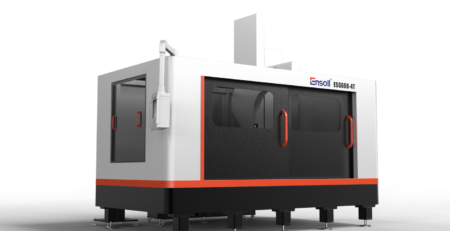
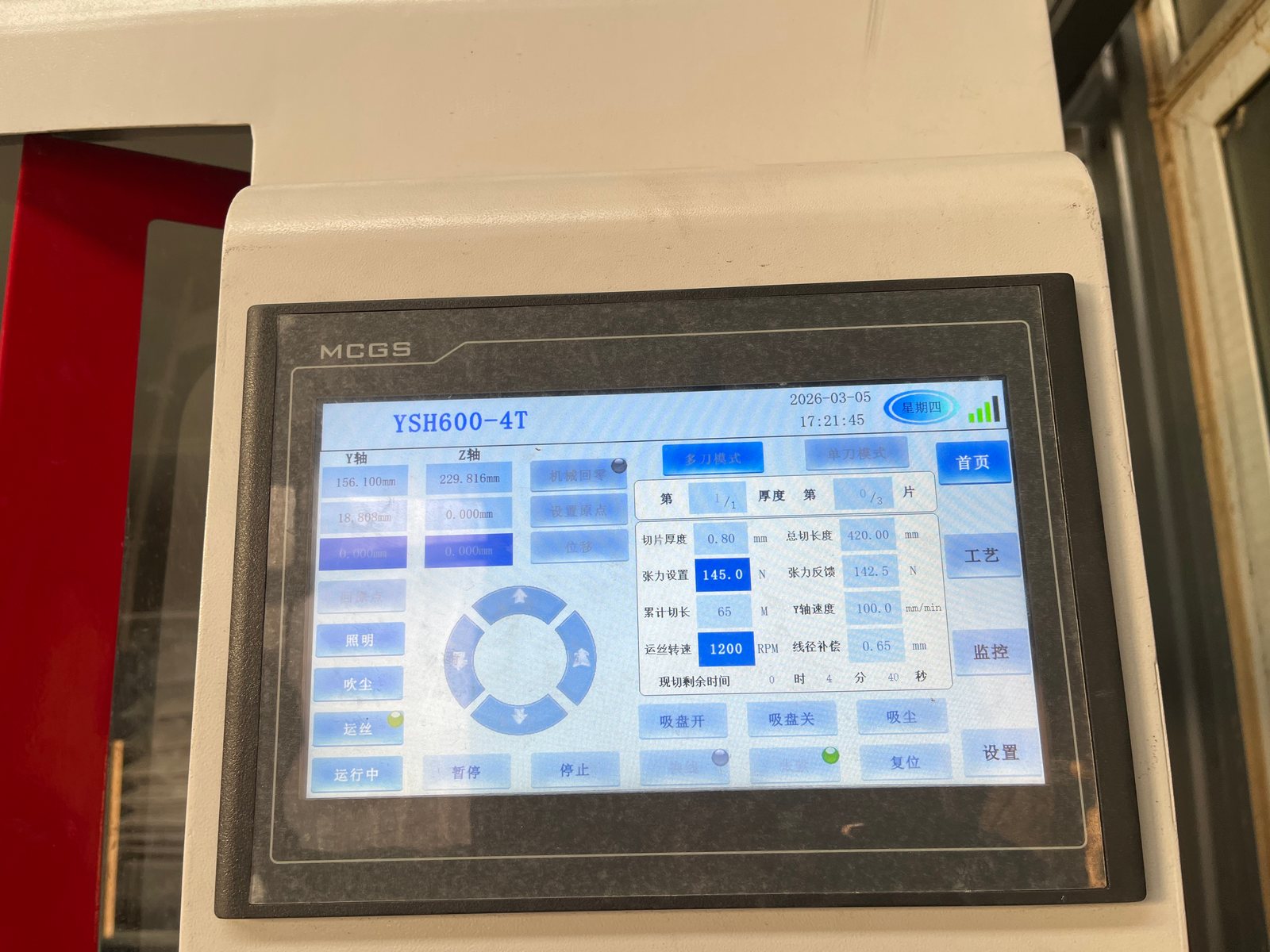
(Polymethacrylimid) structural foam slicing test on an ESH600-4T horizontal
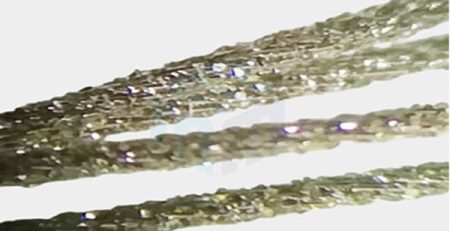
Diamantdrahtsäge-Maschine: ein 0.60 x 3460 mm fully coated
Diamantdraht-Schlaufe, 100 mm/min wire travel speed, 145 N Drahtspannung, 25 m/s wire speed,
60 s wire-bow tensioning time, 17 N·m cutting load and 400 mm Schnittbreite, with dry cutting. It explains
what each parameter does on a cellular foam, which way to move it when a defect appears, and how to establish a
starting set for a new foam grade or slice thickness.
Wesentliche Erkenntnisse
- Validated window for 0.8 mm PMI foam slices on an ESH600-4T: 0.60 x 3460 mm fully coated wire loop, 100 mm/min feed, 400 mm Schnittbreite, 145 N Spannung, 25 m/s wire speed, 60 s wire-bow time, 17 N·m load, dry cutting.
- PMI foam fails by compression and tearing of the cell skeleton, not by brittle fracture, so feed rate – the load-setting parameter – is the first thing to reduce when a defect appears.
- Dry cutting is the default for PMI foam: coolant would enter the cells and would have to be cleaned and dried out afterwards.
- The load readout is a monitor, not a setting; a rising load trace during a cut is the earliest warning that a parameter has drifted out of band.
- This window produced TTV 0.013-0.050 Mm (mean 0.036 Mm), thickness tolerance +/-0.043 Mm, average Ra 0.68-0.82 um and maximum chipping 5.5-7.1 um.
Why PMI Foam Needs Its Own Parameter Set
PMI foam is a low-density structural foam with a uniform cellular structure and good specific strength and
specific stiffness. Under a diamond wire it does not behave like a dense material: the abrasive grains act on the
foam skeleton, and the failure mode at excessive load is compression and tearing of the cells rather than clean
shearing. Deshalb können Parameter, die bei einem dichten Thermoplast funktionieren, nicht einfach übernommen werden. Der
Das unten bestätigte PMI-Fenster wurde durch Abgleich von Maschinenstruktur, Draht, Schneidverfahren und Parametern mit
der Zellstruktur des Materials.
Bestätigtes Parameterfenster für 0.8 mm PMI-Schaumscheiben
| Parameter | Wert |
|---|---|
| Drahtdurchmesser x Schleifenlänge (Mm) | 0.60 x 3460 |
| Drahtvorschubgeschwindigkeit / Vorschubgeschwindigkeit (mm/min) | 100 |
| Schnittbreite (Mm) | 400 |
| Drahtspannung (N) | 145 |
| Drahtgeschwindigkeit (M/s) | 25 |
| Drahtspannungszeit am Bogen (s) | 60 |
| Schneidlast (N·m) | 17 |
| Kühlmethode | Trocken schneiden |
PMI-Schaumschneidetests
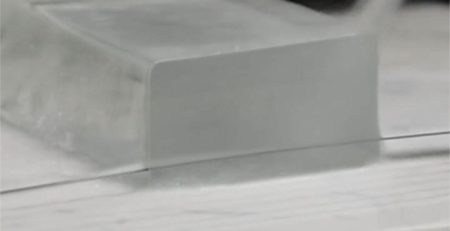
Werkstückbedingungen für dieses Fenster: PMI-Schaum bei etwa MH 2 Härte, Werkstück
400 mm x 400 mm x 50 Mm, Zielscheibe 400 mm x 400 mm x 0.8 Mm.
Was jeder Parameter bewirkt
Drahtdurchmesser und Schleifenlänge (0.60 x 3460 Mm)
Der Drahtdurchmesser legt den Schnittspalt und die Steifigkeit der Schneidkante fest. A 0.60 mm vollständig beschichteter Drahtkreis sorgt für eine
stabile Schleifkante für einen 400 mm breiten Schnitt bei gleichzeitig kleinem Schnittspalt. Die Schleifenlänge muss zur Maschine passen
pulley geometry and is fixed by the machine model rather than chosen per job.
Drahtvorschubgeschwindigkeit / Vorschubgeschwindigkeit (100 mm/min)
This is the parameter that governs cutting load most directly, and on foam it is the first one to reduce when a
defect appears. Feed too high and the skeleton takes a large local force; feed too low and the wire polishes
rather than cuts, which raises heat and wear without improving quality. 100 mm/min is the validated value for
0.8 mm slices.
Schnittbreite (400 Mm)
The cutting width is the length of wire in contact with the workpiece. It scales the total load and therefore
the machine rigidity and tensioning required. A 400 mm contact length on a lightweight foam also raises the risk
of the workpiece moving, which is why the fixture and workpiece support matter as much as the numbers.
Drahtspannung (145 N)
Tension keeps the wire straight under load. Z, u
becomes uneven; n. i
e, d, r
i.
Drahtgeschwindigkeit (25 M/s)
g. On a low-density foam the removal rate
u, n – d
mostly adds wear. d.
Drahtspannungszeit am Bogen (60 s)
e. r
millimetres of the cut under different conditions from the rest, which shows up as a thickness step at the entry
edge of a thin slice.
Schneidlast (17 N·m)
The load reading is the process monitor rather than a setting: it is what you watch to confirm that the
combination of feed, tension and wire speed is actually delivering a stable cut. A drifting or rising load during
a cut is the earliest warning that a parameter has moved out of band.
Adjustment Guide: Symptom, Ursache, Action
| Symptom | Most likely cause | Action |
|---|---|---|
| Ragged or torn slice edge | Cutting load too high for a cellular foam | Reduce feed rate; verify wire tension before changing wire speed |
| Uneven cut face, wandering kerf | Wire bowing – tension too low | Raise tension toward 145 N and confirm the bow settles before entry |
| Thickness step at the entry edge | Cut started before the wire bow settled | Keep the full 60 Drahtbogen-Spannungszeit, bevor der Vorschub greift |
| Scheiben gleichmäßig dünn oder dick | Dimensionsversatz, keine Instabilität | Dickenkompensation auf dem Maschinenziel anwenden; nicht mit dem Vorschub dagegen ankämpfen |
| Lastkurve steigt während eines Schnitts | Parameterabweichung oder Drahtverschleiß | Stoppen, Drahtzustand und Last prüfen, Validiertes Fenster wiederherstellen |
| Oberfläche poliert statt geschnitten | Vorschubgeschwindigkeit zu niedrig für die Drahtgeschwindigkeit | Vorschub innerhalb des validierten Bereichs erhöhen; Kornzustand des Drahts prüfen |
Erstellen eines Parametersatzes für neuen Schaum oder neue Dicke
Das validierte Fenster ist ein Ausgangspunkt, keine universelle Antwort. PMI-Werkstoffe unterscheiden sich in Dichte und Zellgröße,
und Schnittdicke verändert die Steifigkeit des zu schneidenden Teils. In dieser Reihenfolge arbeiten:
- Zuerst die Vorrichtung fixieren. Das Werkstück über die gesamte Fläche stützen, damit der Draht es nicht
schiebt. Auf Schaum, deflection of the workpiece reads as thickness variation and is easily mistaken for a
parameter problem. - Start from the validated window. 0.60 x 3460 mm Draht, 100 mm/min feed, 145 N Spannung,
25 m/s wire speed, dry cutting. - Cut one slice and measure TTV. Use the same nine-point grid method described in our
TTV measurement guide so results are comparable with the reference data. - Move one parameter at a time. Feed rate first, then tension. Change wire speed only if feed
and tension are already at their limits. - Record the load curve. A stable load trace at the chosen settings is the evidence that the
process, not the operator, is controlling the cut.
Results Achieved with This Window
| Measure | Result across four 0.8 mm slices |
|---|---|
| Gesamtdickenabweichung (TTV) | 0.013-0.050 Mm, Durchschnitt 0.036 Mm |
| Dicken-Toleranz | +/-0.043 mm against 0.800 mm nominal |
| Average surface roughness Ra | 0.68-0.82 um |
| Maximum edge chipping | 5.5-7.1 um |
The thickness data showed a systematic negative offset rather than random scatter – the slices ran thin by
0.031 An 0.043 mm against a 0.800 mm nominal. That is a dimensional-compensation problem, not a stability
problem, and is corrected by adjusting the machine target thickness on the next run. The full measurement set
including all nine-point readings is published in the
PMI foam precision slicing test report.
Related Process Data
The same nine-point methodology applied to a dense thermoplastic, with cutting fluid instead of dry cutting,
is documented in the PEEK precision slicing test. A side-by-side comparison of the two
materials and their parameter sets is in
PEEK vs PMI foam: diamond wire cutting comparison.
Häufig gestellte Fragen
What cutting parameters were used to slice PMI foam to 0.8 Mm?
Draht 0.60 x 3460 Mm, wire travel speed (Vorschubgeschwindigkeit) 100 mm/min, Schnittbreite 400 Mm, wire tension 145 N, Drahtgeschwindigkeit 25 M/s, wire-bow tensioning time 60 s and cutting load 17 N·m, on an ESH600-4T horizontal Diamantdrahtsäge-Maschine using dry cutting and a fully coated wire.
Should PMI foam be cut dry or wet?
Trocken. PMI foam is porous, leicht und neigt dazu, Flüssigkeiten aufzunehmen. Trockenes Schneiden hält Kühlmittel von den Zellen fern und entfernt die Reinigungsschritte und das Trocknen, die einem Nassschnitt folgen, was hilft, die strukturelle Integrität und die Maßgenauigkeit der Scheiben zu erhalten. Dies ist das Gegenteil eines dichten Thermoplasts wie PEEK, der mit kontinuierlichem Schneidfluid geschnitten wird.
Welche Drahtart wird für PMI-Schaum verwendet?
Eine vollständig beschichtete Diamantdrahtschleife. Die vollständige Beschichtung erhöht die Kornbindungskraft und die Verteilungsstabilität, unterstützt kontinuierliche Schneidfähigkeit und reduziert die Schwankungen, die durch Drahtverschleiß und Kornabplatzungen verursacht werden. Siehe die Produktpalette der Diamantdrahtschleifen.
Welche Ergebnisse erzielte dieses Parameterset?
Vier 400 mm x 400 mm PMI-Schaumscheiben mit 0.8 mm Nennstärke ergaben TTV 0.013-0.050 Mm (Durchschnitt 0.036 Mm), thickness tolerance +/-0.043 Mm, average Ra 0.68-0.82 um und maximale Kantenabplatzung 5.5-7.1 um. Vollständige Daten finden sich im PMI-Schaum-Schneidetestbericht.
Welche Einstellung sollte zuerst geändert werden, wenn die PMI-Schaumkante reißt?
Reduzieren Sie die Vorschubgeschwindigkeit. Reißen, Lokale Kompression und eine ungleichmäßige Schnittfläche bei einem Zellschaum sind lastgetriebene Probleme, nicht geschwindigkeitsgetriebene: Übermäßige Last komprimiert das Schaumgerüst, anstatt es zu schneiden. Zuerst den Vorschub reduzieren, dann die Drahtspannung erneut überprüfen, bevor die Drahtgeschwindigkeit verändert wird.
Technische Inhalte überprüft vom Ensoll-Engineering-Team – ein Hersteller von Diamantdrahtschleifen mit 10+ Jahre der Produktionserfahrung.