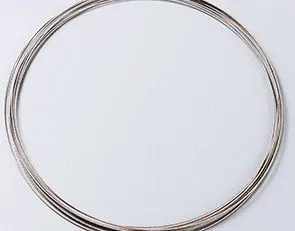
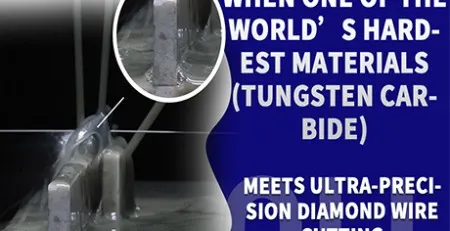
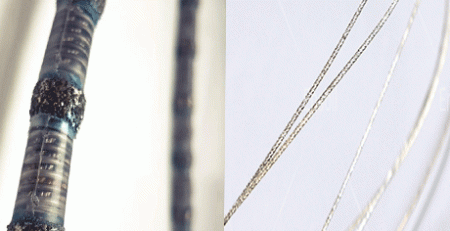
金刚石线环切割相比传统切割方法在半导体和精密制造中具有显著进步. 该技术采用嵌有金刚石磨料颗粒的连续钢丝环,以极高精度切割各种材料 . 金刚石颗粒, 牢固嵌入钢丝表面, act as microscopic cutting tools that gradually abrade the material through a controlled process that minimizes mechanical stress and thermal damage .
The widest use of that principle is硅片切割, where kerf loss is measured directly against ingot cost.
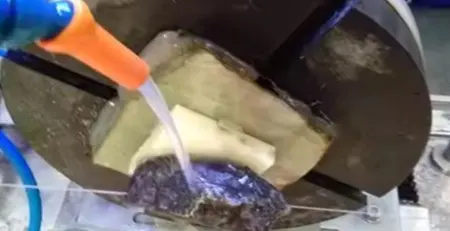
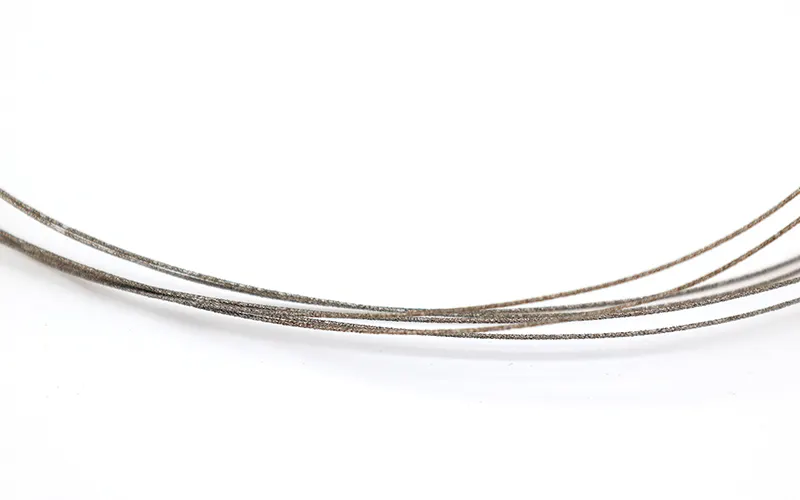
The fundamental components of a金刚石线环cutting system include several critical elements. The diamond-impregnated wire itself is specially engineered with industrial diamonds uniformly distributed and bonded to its surface . A precision guidance system consisting of sophisticated rollers and tensioning mechanisms maintains wire stability and alignment during operation . 先进的控制系统, typically Computer Numerical Control (CNC), manage cutting parameters with exceptional accuracy , while integrated cooling systems manage temperature and remove debris from the cutting zone .
1.2 Historical Development and Industry Adoption
The evolution of diamond wire cutting technology has been driven by the semiconductor industry’s relentless pursuit of higher precision and efficiency. Traditional methods such as mechanical blade sawing and laser cutting presented significant limitations, including microcracks, thermal stress, and substantial material loss . The emergence of diamond wire solutions addressed these challenges directly, offering superior cutting performance with reduced kerf loss and minimal thermal impact .
Blade sawing loses on the same count in切割氧化铝陶瓷, where the subsurface damage layer has to be ground away afterwards.
The transition from free abrasive slurry wire sawing to fixed abrasive diamond wire sawing (DWS的) marked a pivotal technological shift in the industry . This development was particularly crucial as wafer thicknesses continued to decrease while diameter sizes increased, creating more demanding requirements for cutting precision and material conservation . Today, diamond wire loop cutting has become the dominant slicing technology for silicon wafers and numerous other semiconductor materials .
The parameter set behind that shift is documented in our硅片切割 指南. (链接 2 之 2)
2 Single-Wire Diamond Loop Cutting Technology
2.1 Working Principle and System Architecture
Single-wire diamond loop cutting machines utilize a single cutting wire to perform precision cutting operations . The fundamental working principle involves a continuous diamond-impregnated wire moving at controlled speeds while guided through target materials. 系统保持精确的张力控制,以确保切割精度并防止线材偏移或断裂 .
Single-wire diamond loop cutting systems offer several distinct technical advantages that make them indispensable for certain applications. Their exceptional flexibility enables the processing of complex shapes and contours that would be challenging for multi-wire systems . This capability is particularly valuable for prototyping and research applications where varied cutting paths are required.
The technology delivers superior cutting precision with accuracy levels reaching ±0.03mm or better, making it ideal for applications where minimal kerf loss and exact dimensional control are critical . Single-wire systems also demonstrate remarkable material versatility, effectively processing diverse materials including silicon, 砷化镓 (砷化镓), 蓝宝石, and various ceramic substrates . The simplified operational workflow requires less extensive setup and calibration compared to multi-wire systems, reducing preparation time for smaller production runs . 此外, these systems feature a compact physical footprint that requires less facility space, making them suitable for laboratory environments and smaller manufacturing facilities with space constraints .
That versatility extends to the hardest common substrate, 哪里 碳化硅切割的方法rewards low, stable force over raw speed.
2.3 Applications and Use Cases
Single-wire diamond loop cutting finds extensive application across multiple industries where precision cutting of smaller volumes or complex shapes is required. In research and development laboratories, these systems enable sample preparation, prototype development, and experimental material processing . 医疗器械行业利用单线技术制造精密零部件, 外科手术器械, 以及需要严格尺寸公差的专用植入物 .
该技术对于小批量生产专用零部件尤为有价值,因为快速设置和更换功能提供了显著的操作优势 . 在电子和半导体领域, 单线系统执行专用基板的复杂切割任务, 化合物半导体, 以及多线系统在经济上不切实际的低产量生产 . 此外, the gemstone and precision optics industries leverage the exceptional accuracy and surface finish capabilities of single-wire diamond cutting for processing valuable materials where minimal kerf loss directly impacts profitability .
Multi-wire diamond loop cutting machines employ multiple cutting wires arranged in parallel to perform simultaneous cutting operations . This configuration enables mass production by processing multiple workpieces or large-area materials in a single operation. The working principle involves numerous diamond-impregnated wires spaced at precise intervals on a guidance system, creating a dense cutting network that operates concurrently .
Throughput of that order is what separates a lab tool from a production金刚石绳锯切割机.
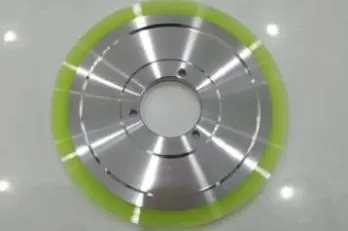
The system architecture of multi-wire machines is substantially more complex than single-wire configurations. Critical components include an advanced guide wheel system that supports and drives multiple wires while ensuring uniform distribution and stable movement . A sophisticated tension control system maintains consistent tension across all wires, which is crucial for uniform cutting performance and preventing wire failure . The comprehensive workpiece clamping system secures large or multiple workpieces during processing, while the advanced motion control system coordinates the complex interaction of multiple cutting wires and workpiece movement . This integrated design prioritizes high-volume production efficiency over flexibility, making it ideal for large-scale manufacturing operations.
3.2 技术优势和性能特点
Multi-wire diamond loop cutting systems offer compelling advantages for high-volume production environments. Their exceptional throughput capacity enables simultaneous processing of multiple workpieces or large-area materials, dramatically increasing production efficiency . This technology delivers superior production consistency across batches due to synchronized cutting parameters and conditions for all wires .
The optimized cost efficiency for mass production runs results from significantly reduced processing time per unit and lower labor costs relative to output volume . Multi-wire systems demonstrate exceptional capability for processing large-format workpieces that would be impractical or time-consuming with single-wire approaches . 此外, these systems provide enhanced utilization of raw materials through optimized cutting patterns and simultaneous processing that minimizes setup-related waste .
Large-format optical substrates are the clearest example, and the waste arithmetic is covered in our光学玻璃切割 指南. (链接 2 之 2)
3.3 Applications and Use Cases
Multi-wire diamond loop cutting technology has become the industry standard for numerous high-volume manufacturing applications. In the photovoltaic industry, these systems are extensively used for slicing silicon ingots into wafers for solar cells, where production volume and cost efficiency are critical competitive factors . The semiconductor industry employs multi-wire technology for mass production of silicon wafers for integrated circuit manufacturing, leveraging the capability to process multiple wafers simultaneously with consistent quality .
Measured results for the rod-slicing step itself – TTV, roughness and chipping on a phi330 mm rod – are reported in our study onprecision slicing of silicon rods.
The advanced materials sector utilizes multi-wire systems for large-scale processing of technical ceramics, glass substrates, and composite materials where dimensional consistency across multiple components is essential . 在电子行业, these machines produce multiple components simultaneously from larger substrate sheets, optimizing material usage and production efficiency . 此外, the optical industry benefits from multi-wire technology for processing large glass and crystal substrates used in display technologies and optical components, where consistency across multiple pieces is paramount .
The single-material version of that problem is treated in our guide to切割氧化铝陶瓷. (链接 2 之 2)
– Facility Requirements: Multi-wire machines typically have a larger physical footprint, require more substantial infrastructure support, and need more extensive utility connections . Single-wire systems feature more compact designs with lower utility requirements, making them suitable for diverse facility environments .
4.2 Economic Considerations and ROI Analysis
The economic decision between single-wire and multi-wire diamond loop cutting technologies involves analyzing multiple financial factors:
– Capital Investment: Multi-wire systems command significantly higher initial purchase prices due to their complex mechanical systems, advanced control technology, and larger structural components . Single-wire systems represent a more moderate capital investment, making them more accessible for smaller operations and specialized applications .
– Operational Costs: While multi-wire systems have higher ongoing maintenance costs and more expensive consumable components, their superior throughput typically results in lower cost per unit in high-volume production environments . Single-wire systems generally have lower ongoing maintenance expenses but higher labor costs per unit produced .
– Return on Investment Timeline: Multi-wire systems typically justify their substantial capital investment through massive production volume, with ROI periods that can be surprisingly short in high-utilization scenarios . Single-wire systems often demonstrate favorable ROI through operational flexibility, reduced setup times for diverse tasks, and capability to process high-value materials with minimal waste .
– 生产可扩展性: Multi-wire systems deliver exceptional scalability for established product lines with predictable demand patterns . Single-wire systems provide scalability through flexibility and adaptability to changing product requirements rather than pure volume capacity .
5 Current Industry Status and Technological Trends
5.1 Market Adoption and Application Trends
Diamond wire loop cutting technology has experienced significant market penetration across multiple industries, with particular dominance in semiconductor and photovoltaic manufacturing . The transition from traditional cutting methods to diamond wire solutions has accelerated as product thicknesses continue to decrease while quality requirements become more stringent .
In the photovoltaic industry, multi-wire diamond loop cutting has become the established standard for silicon wafer production, with manufacturers aggressively pursuing wafer thicknesses below 150 micrometers while simultaneously adopting finer diamond wires with diameters under 35 微米以最大化每个锭的产量 . 半导体行业继续利用单线和多线技术, 根据生产量进行选择, 材料特性, 以及精度要求 .
– 线材技术进展: Recent years have witnessed significant improvements in diamond wire construction, including enhanced diamond distribution patterns, advanced electroplating techniques that improve diamond retention, specialized coatings that reduce friction and extend wire lifespan, and increased wire lengths now reaching up to 3,000 meters for continuous operation .
– Machine Control Systems: Modern diamond wire cutting systems incorporate increasingly sophisticated control features including real-time tension monitoring and adjustment, vibration damping technologies that minimize vibration-induced imperfections, intelligent parameter adjustment systems that optimize cutting conditions based on material feedback, and integrated metrology systems that enable immediate quality verification .
– Hybrid Processing Methods: Research and development efforts are exploring assisted machining methods such as ultrasonic vibration-assisted DWS (UV-DWS), electrical discharge vibration-assisted DWS (ED-DWS), and electrochemical-assisted DWS (EC-DWS) that enhance cutting performance for challenging materials .
– Automation and Industry 4.0 集成: Both single-wire and multi-wire systems are incorporating higher levels of automation, including automated loading/unloading systems, in-process quality monitoring, predictive maintenance capabilities, and seamless integration with factory digitalization platforms .
6 Implementation Considerations and Selection Guidelines
6.1 Technology Selection Framework
Selecting between single-wire and multi-wire diamond loop cutting technologies requires careful analysis of specific production requirements and operational constraints:
– Production Volume Assessment: 多线系统在高产量生产中具有显著的经济优势,尤其是在标准化切割要求下 . 单线系统在低到中等产量生产中提供更好的对准效果, 多样化的产品组合, 以及需要频繁切换的应用 .
– 质量要求: Applications demanding the highest levels of precision, minimal kerf loss, and superior surface finish often benefit from single-wire processing . Applications where consistent quality across multiple pieces is paramount align well with multi-wire capabilities .
6.2 Implementation Best Practices
Successful implementation of金刚线环切技术involves addressing several critical operational factors:
– Comprehensive Operator Training: Both single-wire and multi-wire technologies require specialized operational knowledge, particularly regarding wire tension management, cutting parameter optimization, and preventative maintenance procedures .
– Maintenance Protocol Establishment: Multi-wire systems demand more extensive maintenance schedules due to their complex guidance systems and multiple wire management components . Single-wire systems require less intensive but equally critical maintenance focused on precision components and guidance elements .
– Supply Chain Planning: 金刚石线环have finite service lives, requiring proactive inventory management to prevent production interruptions . Multi-wire systems typically have higher consumable costs due to multiple simultaneous wire replacements .
– Process Validation Procedures: Implementing comprehensive quality assurance protocols is essential for both technologies, with particular emphasis on consistency monitoring across multiple wires in multi-wire systems .
7 结论
The diamond wire loop cutting landscape presents two distinct technological approaches, each with compelling advantages for specific applications. Single-wire diamond loop cutting technology delivers exceptional flexibility, superior precision for complex geometries, and reduced operational complexity, making it ideal for specialized applications, lower volume production, and research environments . Multi-wire diamond loop cutting offers unmatched production throughput, optimized mass production economics, and exceptional consistency for high-volume manufacturing of standard components .
As material technologies advance and manufacturing requirements evolve, both single-wire and multi-wire diamond loop cutting systems continue to develop through technological innovations that enhance precision, 效率, and operational reliability . The ongoing development of advanced wire formulations, improved guidance systems, and enhanced control technologies ensures that both approaches will remain relevant and valuable for precision manufacturing across diverse industries.
Manufacturers seeking to implement diamond wire loop cutting technology should base their selection on comprehensive analysis of production requirements, 材料特性, quality expectations, and economic considerations rather than presuming universal superiority of either approach. With careful technology selection and proper implementation, diamond wire loop cutting delivers exceptional value through superior cutting quality, reduced material waste, and enhanced production efficiency across countless industrial applicatio
常见问题
What is the difference between single-wire and multi-wire diamond cutting?
A single-wire (金刚石线环) machine drives one closed loop of diamond-coated wire to cut one kerf at a time. A multi-wire saw guides dozens of parallel wire strands so many slices are cut in one pass.
Which is better for R&D or small-batch production?
Single-wire diamond loop machines: they cost far less, change over quickly between materials, and can do contour cutting that multi-wire saws cannot.
When does a multi-wire saw make more sense?
In high-volume standardized wafer production (例如, photovoltaic silicon bricks), where dozens of identical slices per pass justify the higher machine cost and setup complexity.
Can a diamond wire loop do contour cutting?
是的. CNC-controlled single-wire loop machines cut curves and irregular shapes, which is a key advantage over multi-wire saws limited to straight parallel slicing.

 3.1 Working Principle and System Architecture